Sunday, November 6, 2011

Counting our Blessings : Living with Parkinson's Disease

This is not really a genealogy blog about ancestors; It is about the life my husband and I have lived over the past years and will serve as a story for generations to come. 

A few months ago, I was approached by Parkinson's Victoria, wanting to know if I would be willing to be interviewed for an article, describing life as a carer for someone who has had PD for 25 years. The article was used as part of Parkinson's Victoria's Christmas Appeal, 2011. This morning, without notice, I received the actual copy, sent to all Parkinson's Victoria members. It was a slight shock, to see your words on such a personal matter in print.

I was interviewed by a wonderful lady named Indira Kennedy. A half hour interview turned into a two hour chat. I described the problems we have faced, warts and all, and she came up with a wonderfully sensitive take on the difficulties we face on a daily basis. I have added some details to round out the story in italicized type.
Here is how she worked a terrible tale into a blessed life:

Counting Our Blessings

I may not have the man I married but I do have much to be grateful for

Living with Parkinson’s takes courage and strength, dedication and patience. It can also take the things you love - if you let it.

My husband Paul has lived with this challenging illness for over 25 years. He was only 32 years old when he was diagnosed, but probably had developed the disease a few years prior to diagnosis. It was so early in life and such early days in understanding how to manage it and live well with an ‘older person’s disease’.

I met Paul as a father of two girls. I have three boys. My own health is challenging, living with chronic pain from a bad fall,  and sometimes I wonder who is looking after whom! Between us, as a second marriage for both, you could say we had a lot on our plate.

At first Parkinson’s wasn't so noticeable. Paul had a lot of coping skills and hid the symptoms well. As a scientist he knows everything there is to know about the physiology of disease. Paul was a senior research scientist at CSIRO for 22 years, specializing in Molecular Biology. He also won many awards including the prestigious "Chairman's Medal". He loves history and immersed himself in the thousands of books lining our home; Seriously! He has an amazing sense of humour and a wonderful way with language. But at an emotional level, it’s another thing altogether.

You could say Paul doesn't want to know, to face up to what has gradually taken so much of him. But what I have learned is that Paul hates confrontations, always looks for peace and doesn’t allow his condition to rob him of his good nature.
At Cross Country, Benalla

For example, Paul was fabulous with the children when they were young. He took them to Little Athletics every Saturday during summer, and cross country during winter, despite his condition. When he could no longer drive, he took a taxi. He quietly soldiered on.

As for me, I have learned to express the emotion for both of us. I know what it is to go through the stages of grief, having lost both my parents around the same time Paul's health began to worsen, to feel robbed of the fit & strong man I married, to have the children struggle to confront the reality of a dad who was ill.

Many times I have fallen into total exasperation, burdened by the dependency on me. At times it was like looking after my father in the last months of his life - Paul had become an "old man". Sometimes it feels like I’m flying blind dealing with how Paul is feeling or what he needs to be comfortable. I’ve come home to find him frozen in muscle spasms on the floor, or in the full throes of tremors. I had to give up work, in 2008 just as he did, aged 49 two years previously, to try to live better with the progression of this demanding disease. 

My saving grace was contacting Parkinson’s Victoria when I just didn’t know how to go on. Their useful tips about simple things like shirts with press studs, tracksuits with no elastic in the ankles, slip on shoes, all gave me a new view of daily life. Getting dressed and doing up buttons on a shirt or tying shoelaces was beginning to take half an hour for each task, so I was dressing him, an embarrassing proposition for a man in his prime!

But more importantly, I learned what side effects to expect from the many drugs Paul needed to control his spasms, to know what stages to expect as the disease took its path, got referrals to other services, and I learnt what our options were. One of those options was a change in his drug regime which  included a 24 hour infusion pump of the dopamine agonist of Apomine, changed daily, until there was nowhere to put the butterfly needle as he was so skinny, and finally, Deep Brain Stimulation in May of 2010. Note: The solutions that suited Paul are not for everyone. Please talk to your neurologist!
Infusion pump and needle
Even more so, I was grateful to have a time to cry and let go when no-one else could truly understand. I’ve needed to speakup and have someone support us. Parkinson’s Victoria got us on the right track when another track wasn’t working. They referred us to the right agencies who arranged for easy access to the bathroom and install hand rails, and find respite care. They helped us to bring the whole emotional experience into one that became, ‘This is how it goes.’ I learned to accept and keep fighting on.

Charging across a Southern US battle field

We travelled to America for three months, driving 2500 miles, mainly looking at Civil war sites in the Southern states - one of his passions while it was possible, and had the trip of a lifetime together. And we can still holiday in places where we are still able to meet Paul’s needs.

These days Paul snoozes a lot during the day, and seems slower. But his mind is just as sharp and his love is just as powerful.

Thankfully, Parkinson's will not shorten Paul’s life - he can expect to live as long as any averageAustralian male. But Parkinson’s will continue to challenge us, and sometimesin unpleasant ways. We will still need Parkinson’s Victoria to help us, every step of the way.

There is no doubt Parkinson's has changed Paul a lot. I might not have the man I married, but I do have the man who in his own way keeps on fighting along side me, in the best way he knows how. And we constantly count our blessings.

Everyone has their own story, and their own journey. Parkinson’s Victoria remains dedicated to taking those steps with us all.

Please give generously to this appeal. We know, as most likely you do, the incredible difference this service makes to so many lives.

Thank you and please have a safe and joyful festive season.

Linda

Friday, October 14, 2011

The Death of William Smith : A PITIFUL STORY

William Smith, my paternal Great Grandfather born in 1854, was the son of Owen Smith and Christiana Matheson (from the Isle of Skye). Owen disappeared from the records, however in 1857, Christiana went on to marry Jabez Smith, a shepard then later a store-keeper on the station "Boorolong" near Armidale.  Jabez and Christiana had three children, Eliza and Catherine - twin girls, born in 1858 and Charles born 1860. 

Jabez wrote his will in 1885, and died in 1888. His will states that "My stepson William to have all my horses and 1 dray & harness". The probate papers for Jabez' will describes these items as " 1 harness (old) worth £1, 10/- and 1 dray (old) worth £6". When in total his whole estate was valued at probate for just under £1000 with the majority of his estate being granted to his son Charles and his son in law, John Archibald Chisholm ; it seems step-sons were not very important in the scheme of things.

In 1881 William married Agnes Jane Johnson. I do not know why William and his family left  the thriving Boorolong station, and moved to such a remote area. I might assume that he was no longer welcome at Boorolong after the death of his mother in 1894 and perhaps  they thought he might "Make his Fortune"  carting goods to the miners whom had flocked to the area  because of the gold rush that was happening along Swamp Oak Creek during that time, but those reasons are now lost to time. Together William and Agnes Jane had 4 sons and 4 daughters; William Thomas, Ernest Jabez, Albert James, Henry Owen, Eliza Pearl, Janet Christina, Ethel May, and later, an illegitimate daughter, Vida F. Smith

However in 1895 tragedy struck. I was recently reading a book called Three of a kind : a history of Niangla, Weabonga & Ingelba by Claire Brazel et al. There was no mention of the Smith family in the index, although, from NSW death certificates held by me, I already knew that William had died at "Swamp Oak" - later renamed Weabonga in 1917. I was casually reading some of the small inserts of newspaper clippings that illustrate chapters in this book, when I was came across this passage on page 161 which rocked me to my core:

A PITIFUL STORY:- A sad story of destitution reaches us from Swamp Oak (writes the Walcha “Witness”) A Mr [William] Smith, a carter by occupation, has been living with his wife [Agnes Jane Johnson] and family near the school there. One boy got injured and was taken to Tamworth Hospital with a broken leg. From inquiries made by Constable Payne it appears the rest of the family were sleeping in the house without one blanket between them. Sickness set in, in the shape of inflammation of the lungs. The residents of Swamp Oak subscribed a little money and sent the father to Tamworth for medical advice. He reached Tamworth, but appears to have got no advice and no medicine for the children. On his return, although he did not complain, it was noticed that he was bad. Now the father and two boys have died, and the mother and remaining two [where were the other three?] children are in a bad state. Constable Payne came into the town – having ridden through from Tamworth and made arrangements for the admission of the mother and two children to the Walcha Hospital. Mr W. Moore has gone out for them.
Tamworth Observer, 24th August 1895

This trip, done either on horseback, by dray or by foot would have been no mean feat. The distance between Weabonga and Tamworth is about 45.5 miles, and the terrain is steep  and wild and the tracks at that time, rough.

from Google Maps 2011

I had previously found a plaque inscribed with the name  "W. Smith and his two sons" from  their burial place at the Weabonga Cemetery, with only minimal details listed. I wrote to the Tamworth Historical Society filling them in with the missing details and asked if they had any information regarding an outbreak of diphtheria  - the offical cause of death given on  the NSW Death certifcates of William and his two sons, Henry Owen  (aged 10) and Albert James (aged 6) - in the area during July and August (the months of their death) of 1895, but they could not give me any answer.
 

Weabonga Cemetery plaque - from Australian Cemeteries Index

Information on Diphtheria:
"Diphtheria is aninfectious disease which primarily affects the mucous membranes of therespiratory tract (respiratory diphtheria).
Throughouthistory, diphtheria was a leading cause of death among children, and it wasonce referred to as the "strangling angel of children." Thediphtheria bacterium was first identified in the 1880s. In the 1890s, theantitoxin against diphtheria was developed, with the first vaccine beingdeveloped in the 1920s.
The signs andsymptoms of respiratory diphtheria are caused by the bacterium's ability tocause a localized inflammatory reaction of the cells lining the upperrespiratory tract. In certain cases, the disease can become more severe andwidespread, and it can involve other organs of the body as well. 
Diphtheria is transmitted to closecontacts via airborne respiratory droplets. Overcrowding and poor livingconditions can further contribute to the spread of diphtheria."


Family lore always had William and the two children dying, after his horse and dray were  broken up and washed away while trying to cross a flooded and swollen creek.

It is a story worthy of more investigation, but no matter what the circumstances, the idea of my Great Grandparents and their children "living without a blanket between them" will always send a shiver down my spine.

Sources: 
NSW BDM Certificates
Australian Cemeteries Index
Three of a kind : a history of Niangla, Weabonga & Ingelba / Claire Brazel et al, 1991
Google Maps 
MedicineNet.com

    Tuesday, August 30, 2011

    Arthur Roberts : From Boyhood to Fatherhood : The Making of a Good Man

    The Life and Times of Arthur Thomas Herbert Roberts, as told by his daughter Marjorie Roberts : edited by his Granddaughter, Linda.


    Arthur Thomas Herbert Roberts, as he always called himself, on official occasions or Arthur, on formal occasions and Artie to friends, was born on the 21st of January 1898, at his parent’s home in Riley Street, Surry Hills; an inner city suburb of Sydney, which at that time was well known as a slum area. A good description of the area and times can be found in the novel “Foveaux”  by Kylie Tennant.

    He was the 2nd eldest of eight children born to Thomas Roberts and Elizabeth Olive Dillon.The grandparents of both his parents were convicts, sent from Britain to New South Wales between 1830 and 1850. John Roberts and Sophia Chapman were his paternal Great grandparents, while his maternal Great Grandparents were Olive King and James Lefroy. Arthur's eldest sibling, Olive was born in Surry Hills in 1896, while his youngest, Mavis France, was born in 1916 at their new home "Olveena" in Austral Street, Long Bay, where she lived for the whole 91 years of life.

    As a child he used to walk the 8 miles out to Long Bay with his father Thomas, to visit his aunt, Hannah Roberts, his father’s sister. Hannah had married Lawrence “Larry” Burns in 1896, and had moved to Long Bay around 1900. In 1910 Arthur’s family also decided to move from the inner city to the almost unknown suburb of Long Bay,with its fresh air, clean drinking water, seaside and space. Long Bay had been “settled”  less than 25 years earlier. But for many thousands of years had been home to the local Aboriginal people, many who still resided there, while the newcomers built around them.

    A.T.H. Roberts, 1915
    By this time, at the age of 12, Arthur had finished his schooling, eventually training as a tinsmith, making travelling trunks.

    At the age of 17 and 10 months, on the 8th of November 1915, he joined the Australian Imperial Force and was enlisted into the 19th battalion (The South Sydney Battalion)

    Records show that he lied about his age, which is listed as being 18 years and 9 months. The Army records also show that he was 5’ 2” and weighed 8 stone, 3 pounds, when he left Australia on the 12 December from Sydney, New South Wales, on board HMAT Berrima. 
      
    HMAT Berrima
    After stopping over in Alexandria were he was transferred to the 2nd Battalion A.I.F. (the battalion he remained attached to for the rest of the war), he arrived in Marseilles, France in March of 1916, and by late July 1916, was wounded in the battle of Pozieres, when  up on a church wall, a shell exploded and a piece of shrapnel was lodged in his temple. Arthur was one of only a handful of men to survive such an injury, but he always claimed that he survived because he was ordered to walk from the front line to find medical assistance, as the battalion was in retreat.  In his words, “the circulation from walking helped me survive”. He was eventually sent to the Third West General Hospital near Cardiff, Wales in August of 1916 for recovery, but by October of 1917, he was back in France. Put on cooking duties, he spilt a large pot of boiling water on his right arm, and was again sent for medical treatment.

    He returned to Australia on His Majesty’s Troop Ship, “City of Poona”; leaving Southampton in England on the 28th March 1919, and arriving in Melbourne in Victoria on the 14th May 1919, from where he had to make his way home to Sydney by train; a distance of some 600 miles.


    On his return home, he was presented with a special 9 carat gold medal inscribed “Pres TO, A.T.H. Roberts, from his friends A. & AE SUMNER, on his return from the, GREAT WAR, 17. 5.19”  ; Mr Sumner being the well known and respected local Anglican Minister at St. Mark's Church of England.


    Once home, even the peaceful, sleepy suburb of Long Bay could not settle his nerves. He left Sydney and “went bush” down the south coast of New South Wales near Shoalhaven, staying away for four years. On his return home around 1923, he bought a horse and cart and went around the local area selling fruit and vegetables, many of which he bought from the local Chinese market gardeners at Matraville. When a green grocer’s shop opened in Long Bay, it was Arthur who supplied them with their produce.

    In 1924 he bought a Ford truck to carry on his old business more effectively. In the year before he passed away, John Anderson, a pioneer of Long Bay who had had a long running carting business, sold his business to Arthur, whom he thought was a dependable character, thus his truck was named "Dependable". The goods Arthur now carted included coal, coke and wood which households burnt for heating and cooking, and ice to keep food cold, as electricity was connected to only a very few of the houses in the area, and refrigerators were not yet on the market; it took his wife Doris until the 1970's to give up her “Ice Chest” for such a new, and in her opinion, useless Electric Refrigerator!
     
    Newly weds, Arthur and Doris,
    leaving All Souls Church
    1924 was an eventful year for Arthur, as he also met his future wife, Doris Louisa Morgan, at one of the many dances that were regularly held at Anderson's Hall in Victoria St. In June 1926, they were married at All Souls Church of England in Petersham, back near where they had both been born.

    Arthur and Doris in their new home
    The newlyweds settled in a cottage named “Longhaven” in Prince Edward St. Their first daughter, Doreen Lorraine was born in 1927. Business remained promising, and Arthur bought a number of housing blocks to ensure his family’s future. 

    When in 1929, the world was hit by an economic depression, Arthur continued to give service to clients even if they could not pay. The couple began to argue, as Doris believed that many families whom had pleaded poor, could in reality, afford to pay as many husbands worked on 'the quite' or QT as it is said in Australian slang, while her family went without. Arthur however, kept up his charitable attitudes by giving a lift to men he saw walking to Moore Park for food handouts, even though he could barely afford the petrol. He continued to struggle economically, and the blocks of land he had purchased against such an eventuality had to be sold. He would never consider signing up for “The Dole” nor accept handouts himself, but continued to struggle financially, while maintaining his compassionate work. However, soon all his assets were gone and he was left with nothing. 

    Long Bay Fire Station, Raglan St., Malabar
    In 1929 Arthur became a notable member of the local Volunteer Fire Brigade, located in Raglan St, near to where he lived with his new family. Arthur was an active member until 1965, just over 35 years, being given life long membership and a medal for long and outstanding service.

    Arthur was also a founding member of the “Long Bay Social Club”, set up to assist, and provide  sustenance and entertainment for those unfortunates who had settled at Long Bay after losing their livelihoods, homes and sometimes families during the "Great Depression"

    By this time, Arthur and Doris had another daughter to feed; Beverley Frances born in late 1928. Doris had also had stillborn child during this period, and the family must have been in turmoil. His health began to suffer, and on doctor’s orders, he moved with his family to Shoalhaven Heads; his old stomping grounds of the South coast of NSW. The family lived in the back of his truck until he found somewhere to rent.
    Baby Beverley being Bathed


    After six months respite, he returned to Malabar living in Raglan Street, while building a new house for his family, next to his mother's home in Austral Street, on land previously purchased by his father Thomas who had recently died. Many friends aided him in his building work; the blueprints were donated to, and are now held by, the Randwick  and District Historical Society. 
    One boon for this period was the wreck of the ship "The Malabar" in 1931. Despite the official efforts in trying to stop the public taking home the cargo that had washed ashore, or floated in the bay, the temptation was too much for many Long Bay residents; with barrels of butter, nails, wood and many more useful and even life-saving items being there for the taking. Items were hidden when Custom's Officers came to investigate the missing cargo. The SS Malabar contributed to the suburb in one more very important way, and that was its name; In 1933, Long Bay was officially renamed "Malabar"

    Life went on relatively smoothly for Arthur and Doris, though busy working, dancing and raising three daughters; Marjorie had been born in 1933. The beginning of World War II began to impose hardship on the population once more. Being good at his business served him well, and he soon gained employment with the Royal Australian Naval Dockyards as a carrier of goods. Many of the invoices from this period show that he was indeed a very busy man. He continued his work with the dockyards until 1954; well after the war had ended.

    Dances were an integral part of their lives as well as other social activities like organising cricket matches between the warders of Long Bay and Emu Plains Prisons. All the players would load themselves on the back of "Dependable" and Arthur would drive the many miles out past Penrith for the game

    Arthur, along with his father and other family members was a member of the Long Bay Masonic Lodge which is still operating strongly today

    21-4-31
    Lodge Long Bay 569 ANZAC Night


    Arthur passed away in 1985, aged 87, with 8 grandchildren, and 14 great grandchildren, loved by all, he was not just a family man, but an integral part of the whole community

    Arthur and Doris with Great Grandson,
    Patrick, 1981


    Sources: 
    National Archives of Australia, WWI personnel record 
    Family papers, diaries and photographs
    NSW Registry for Births, Deaths and Marriages  
    Archives of NSW photos on Flicka and the National Library of Australia
    Notes taken by his daughter, Marjorie Roberts from talking to her father
    Australian Electoral Rolls
    Randwick : a social history


    Saturday, January 16, 2010

    Memories of my early school years

    In 2009, Malabar Public School, enjoyed 100 years of being a local school with a very close knit community. Alison Jones put together a book to celebrate this Centenary, containing history and anecdotes from pupils and staff, past and present. As a past pupil, this was my contribution, although what was published in the book, "The history of Malabar Public School : celebrating over 100 years" was an unedited version of my story which appears in full below.

    School Begins!
    My first day of school, January 1960
    Malabar Public School, NSW
    1960-1967

    I began my education at Malabar Public School aged four and a half in 1960. My mother, Marjorie Roberts (1938-43) and her sisters, Doreen (1932-37) & Beverley had all attended the same school during the 30’s and 40’s. My mother’s strongest recollection of primary school was during the period of WWII, when the students were taught how to hide under the school desk, whenever an air raid siren sounded. This, and learning how to use a gas mask, must have been both fun and scary for a young girl. Her other memory was of being rapped over the knuckles with a ruler as she wrote with her left hand which was unacceptable in those days – everyone should write with their right hand! Many of my great aunts and uncles, born between 1896 and 1916 also attended Malabar after the Roberts family arrived in the area in 1911. Many of my second cousins were also students there – one was even in my class! And I believe that another generation of the original Roberts clan still attends this great school.


    Malabar Public School, 1940, 1st class
    Marjorie Roberts, mother of Linda Smith, is seated 6th from Left in second row


    On my first day, my mother walked me to school, with a banana and a vegemite sandwich wrapped in grease-proof paper rolling around in my large (to me) cardboard school case. We walked along the middle of Austral Street, which in the 60’s had no street guttering and had beautiful coral trees all along the road. Houses were built only on one side of the road; the rest was heath-land, all the way to Little Bay. I wasn’t scared, nor excited, just full of wonder.

    The Kindergarten classroom was in a new building. Looking back it was probably the best year of my schooling. The classroom was light and bright. There was an aquarium and shells and many different sea objects; rocks, sponges, fish skeletons on display, and I knew I would feel at home there as the beach had always been a part of my young life. I didn’t know much about music, but I was always pleased and delighted when I was chosen to play the triangle – no other instrument interested me. We learnt our arithmetic using brightly coloured Cuisenaire rods, which were always fun to play with and made the early subjects of addition & subtraction, very easy to understand.


    As I progressed, school became much harder. Being one of the youngest children in my year, I was put into a class then known as “Transition” – a composite class of 1A & 2B. Many of the children I had started with ended up in the year ahead of me and I ended up with pupils who had started the year after me. The school was very strict and I remember the whole of the Infants school sitting in an old, cold large and dark room, where we had to learn how to tie our shoe laces. No one was allowed to leave for playtime until they had accomplished this (then) almost impossible task. But learn we did – and very quickly as well.

    Malabar Public School class photo 1A/2B 1962
    Linda Smith 2nd from Right, Bottom Row; 2nd cousin Kenny, 5th from Right, Bottom Row


    We learnt to spell by repetition – all the children reciting the letters out loud after the teacher. We could not move on to a new word until the whole class could spell the word correctly. From Second class till this day, I have never forgotten how to spell CAULIFLOWER! The same method was used for learning our times tables; 2x2=4. 2x3=6… but only up to 12x12=144! When it came to multiplying numbers greater than 13, this method caused many difficulties in later years as gadgets like calculators did not exist then.


    My strongest memories come from Third class onward. Our teacher, Mrs. Helen Strath, seemed very strict. During those years, both girls and boys were allowed to be caned for misbehaviour, and Mrs. Strath did not tolerate bad or silly behaviour. At one time I was in trouble for something, probably daydreaming, and was told to go to the Headmaster and be given three strokes of the cane. Instead I told him that Mrs. Strath wanted the cane for someone else and I was to take it to her. He gave me the cane and I hid in the bushes for 10 minutes or so, then I returned it to the Headmaster. I was eventually caught out and received five, very painful, strokes across the hand. However one lesson I have never forgotten, was once when Mrs. Strath asked me what I was doing, and I, being smart, answered “nothing” – day dreaming again probably! She would not take that for an answer and I was made to stand in front of the class and demonstrate how a person “Did Nothing”. As I stood there, she asked the rest of the class what I was doing. Class mates called out that I was standing, breathing, blinking, shaking probably as well! So no matter what you may think, you are always doing Something!

    The move from the Infants school to the Primary school was a big step. We had never been allowed to interact with the “big kids” and now I was one of them. We were allowed to play on the steel monkey bars and house frame, which were erected on bumpy asphalt down the hill from the Infants school. No one minded if we hurt ourselves, it was all part of the fun of school. Friends would pick each other up to walk to school together and sometimes we would arrive at school early, so we could play without interruption or supervision. We would hide in the coal bin, which was at the end of the toilet block and get up to many stupid things, but no one, so far as I know, was ever seriously hurt; just lots of gravel rash and skinned knees.
    Saluting the Flag at morning assembly
    However, being in Primary school brought to us all kinds of other activities and duties where you had no choice but to participate. Every morning we would line up in our class, one behind the other, in a straight line while the flag was raised and we sang “God save the Queen”. We had to play games like tunnel ball and other really boring ones that I can’t even remember. We had to learn dances like the “Pride of Erin” where all the girls would sit along the benches while the boys were allowed to choose their preferred partner, and then we would slowly and numbly go round and round listening to dull music, which was played on an old portable stereo set, up in the bottom playground.


    The girls liked to play Elastics or Jacks at playtime and lunch. Sometimes we played marbles with the boys, but they had their own games and somehow the areas of play were clearly defined.

    © National Library of Australia
    © National Library of Australia


    One of the horrible rules of my days, was that each child was given a small bottle of milk to drink at morning playtime. The milk would arrive early and be left in crates just inside the gates on Franklin St. No matter how warm or awful the milk tasted, we had to drink it in front of a teacher. You were not allowed to take it away in case you threw it away. Milk at that time was not homogenized as it is today, so there was always a layer of cream at the top which was hard to swallow. The best way of downing this foul stuff was to have a flavoured straw to drink through. The straws were made of paper and had swirls of either chocolate or strawberry powder running up the inside, so when you drank though them, the milk became flavoured – what a great invention they were. The shiny foil lids did come in handy for making interesting things such as Christmas decorations, or we would save them for a “Foil drive”, an early recycling scheme for aluminium.

    In Fourth class, 1965, our teacher was named Mr. Savage, but despite his name, he was a very patient teacher. On the 14th of February of the following year, 1966, Australia’s monetary system was to change from pounds, shillings and pence, to decimal currency, and it was Mr. Savage’s job to teach us how to calculate how much a penny, a pound or two shillings was worth in dollars and cents. Now it is part of everyday life, but then it seemed very complicated. There was a song to help us remember the change over that I can still remember; and it goes like this, sung to the tune of “Click Goes the Shears”

    “In come the dollars and in come the cents
    out go the pounds and the shillings and the pence.
    Be prepared folks when the money starts to mix
    on the 14th of February 1966.
    Clink go the cents folks
    clink, clink, clink. Changeover day is closer than you think.
    Learn the value of the coins and the way that they appear
    and things will be much smoother when the decimal point is here.
    In come the dollars and in come the cents
    out gp the pounds and the shillings and the pence.
    Be prepared folks when the money starts to mix
    on the 14th of February 1966”

    The change from the Imperial System of Measurement was also gradually changing to the Metric System, so we also had to learn things like how to change miles travelled into kilometers, how tall we were in feet and inches into centimeters, a pint (600 ml) of milk into a litre, and how much we weighed from stones, pounds and ounces into kilograms and that was very difficult. After 40 or more years, I still don’t know how tall I am in centimeters, only what my height is in feet and inches!

    In Primary school, each week we had a religious lesson from either an Anglican Minister or a Catholic Priest, for children of the two different faiths. A couple of children in my class, including me, had been Christened in either the Presbyterian or Baptist Church, and we made the argument that, as we were neither part of the Church of England, nor Catholic, we should not have to attend these lessons. It was a pretty weak argument in reality, but we got away with it. Instead we were given (what we thought) the exciting tasks of going to the cake shop to buy morning tea for the teachers, or making copies of new work sheets using what was known as a Roneo machine or mimeograph. This was an early form of photocopying, but much more complicated. The task was accomplished by feeding individual sheets of foolscap sized paper through a roller that copied the image from a stencil, using methylated spirits and ink, which was poured into the machine, so that blue and blurry images and words would appear on the new pages.


    By Fifth class we were beginning to be the “big kids” of the primary school, and the teacher that I loved and respected most of all teachers I have ever encountered, taught us that responsibility went hand in hand with being more senior. His name was Mr. Beath. Fifth class was when we gave up writing in lead pencil, and learnt “running writing” using pen and ink. Each desk had a hole where the inkwell was placed, and our pens were made from plastic and had replaceable metal nibs, for an easy change over when the nibs became bent, broken or split. If our writing was passable, we received our “pen license”, which meant we were now able to do our work using a pen, such as a Bic or Biro.

    The Senior School was forming a choir, and each child had to try out for it by singing alone, in front of all our class mates, and be judged by the teachers as to whether we would be accepted or not. It was a very frightening experience and I remember how frustrated the teachers became when we were singing a Gilbert and Sullivan song with the lyrics “…Tit willow, tit willow….” – we would all burst out giggling as this was basically a forbidden word for children to say, then we would have to start the song all over again. Even after the explanation that a “Tit” was a type of bird, we could not stop giggling!


    Mr. Beath also taught us a degree of religious tolerance and understanding, in days when many children, began to skip Sunday School, and instead go to the beach. But on Ash Wednesday in1966, which in the Christian Calendar is the first day of Lent, in the lead up to Easter, Mr. Beath came to school with an ash cross marked on his forehead. Many of us were confused, but he calmly explained the religious symbolism of the cross and why he chose to appear publicly with his beliefs so visible, as well as why we did not have to if we didn’t believe in the church. Each person was entitled to their own beliefs, and no one should condemn or chastise another because of those beliefs, or non beliefs. If kindergarten was the best year of my schooling, Mr. Beath was by far the very best teacher in all my years of ongoing learning.


    By far the most exciting time at school for me, was the beginning of each year when you bought your new exercise books and covered them with brown paper and cut out specially produced pictures from magazines where spaces were provided for you to put your name, class and school. Before each new school year began I was allowed a new pen and lead pencils, but the most important luxury for me was being allowed to buy a new coloured pencil – a “Derwent ©” coloured pencil! During school holidays, my mother would take me into the city to a specialist stationary shop, and each term I was allowed one new coloured pencil. The range of colours available amazed and astonished me. Each time, it probably took me an hour to decide which colour I would like. These pencils were never wasted, and I still have the stub, about an inch long, of a bright purple one, which was (and still is) one of my favourite colours. Our pencil cases were important too. We had wooden ones that had a sliding lid, and compartments for your rubber and lead pencils, and it would then swing out to reveal your coloured pencils underneath.

    School Badge
    Malabar Public School always took sport seriously, after all, the school motto is “Play the Game”. In summer the girls played softball and we played basketball (now known as Netball) in the winter. There was an A and B team, with fierce competition to be chosen for the “A” team. Every Friday afternoon we played against the other local primary schools, including Soldiers Settlement, La Perouse, Chifley, Matraville, Maroubra Bay and Botany.


    One year, both basketball teams from our class went to Queanbyean, near Canberra for a weekend of competition against their school team. This was organized by Miss Hallam. I can’t remember who won, but it was fun, even though we had never really experienced such cold weather. We each stayed, or were “billeted” at the home of one of the girls from the opposing team. This in effect, made us all friends, and was a very interesting learning, sporting and socializing experience.


    Basketball B Team with billets at Queanbeyan

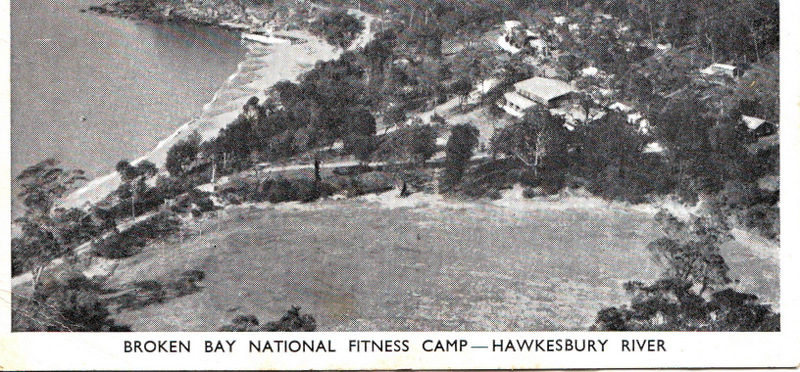
    Playing sport amongst other local schools, and becoming friends with them, was a great asset when we went to the Schools Camp at Broken Bay during 4th and 5th class. We already knew some of the other pupils, so it was not as intimidating as it might have been if we had had no contact with our new bunk mates beforehand. 


    “Broken Bay National Fitness Camp” was a real adventure for those of us that attended. We had to catch a train to Brooklyn, located on the Hawkesbury River, and then we were taken across to the camp by boat. With our suitcases, it was a steep climb up to the camp itself. When we were all assembled, we were allocated huts or lodges for 6 students share and sleep. It was a mixture of fun and responsibility at all times. We explored aboriginal caves and rock art on bush walks, we learnt how to use a bow and arrows, build camp fires, learn new songs, how to make a bull-roarer and do wood work…. all sorts of activities that I had not participated in before. On the other hand, every morning we had “Bunk inspection” and our beds had to be made perfectly. We also had a daily roster of camp duties, in which everyone had to take a turn. These included cleaning the ablutions (toilet - shower blocks), being put on “slops duty” at mealtimes, which meant that all plates were handed to you, and you had to scrape the remains of the mostly inedible food into a great bin, then wash the dishes. But all the same it was a fabulous experience being able to mix with others, as well as learning and exploring places outside of the experiences of our small community at Malabar – a time to see other possibilities in the world.

    During my years at Malabar Public School, there was no school library, nor was the present branch of the Randwick Library yet built. I have always loved reading, and I looked forward to the monthly arrival of the “Mobile Library” – a bus that could only handle two or three students at a time, as shelves lined each wall and we only had a narrow isle in which to search for new treasures. So we had to wait patiently in line for our turn to scrounge the well known shelves for something new to read. This was another place where I had trouble making up my mind in what to choose, but always came away with a load of books to see me through to its next visit.


    In 1967, Sixth class was my final year and the study became serious, as our marks would determine which grade we would be put into at high school (1A, for the brightest students, down to 1E). What we studied is hard to remember. Some lessons were done with the aid of an ABC schools radio program, to which we had to listen attentively, in order to complete projects. Discipline was still very strict, and sports taken just as seriously, and somehow we survived. However it was also a very uncertain period as we were transforming once again; this time from being the “Big Kids” in a small school, to the ‘little kids” in a Big School. There was no orientation program, or opportunity to look at what our future (for most of us) at Matraville High would be like. So with a sense of pride at completing the last year of Primary School, I also felt a tinge of fear as to what the future would bring.


    The end of school brought about one extraordinary event though, which I can’t pass up telling. Exams finished, we were allowed a party in the storage room under the Infants class rooms. Our parents prepared lots of cakes, fruit salads and sandwiches as well as soft drinks, which we brought along especially for the big celebration. Being our last day at Malabar Public School, we did not have to wear our uniform, so all dressed up, ready for the next stage of our life, we had an explosion of silliness which ended up in a massive food fight. We had cream and drinks and all sorts of gunk staining our clothes and sticking in our hair – what a way to go!

    6th class farewell - dancing like dags (Left) while the School Captain gives a speech (right)